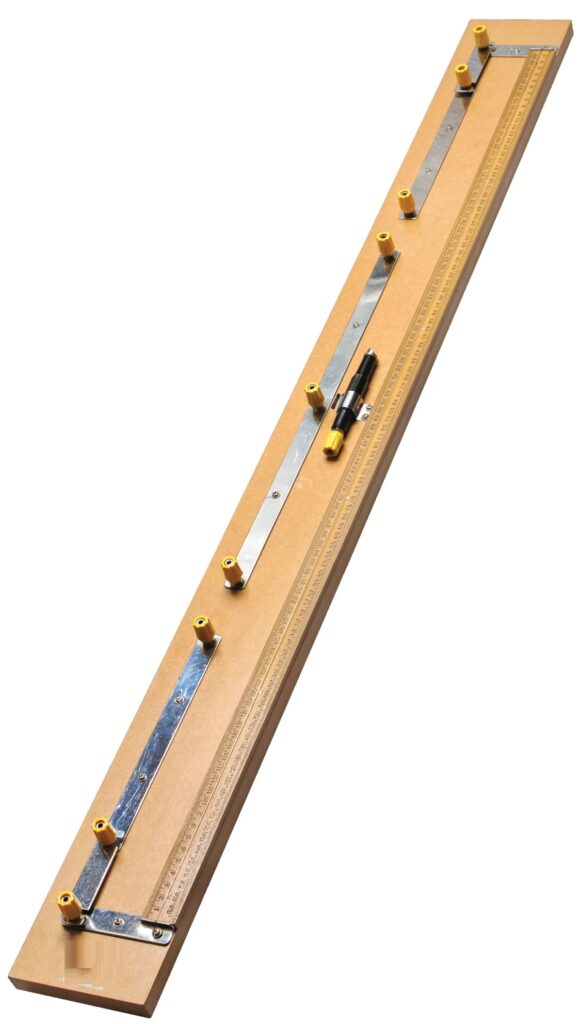
Bridge has broad, heavily plated brass strips mounted on polished hardwood base.
Wheatstone Bridge One Meter, Four – Gap
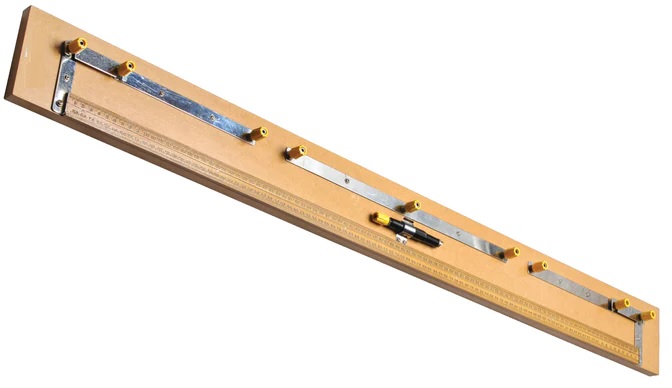
This substantial bridge has broad, heavily plated brass strips mounted on polished hardwood base. Terminals with 4 mm sockets are provided. 24 SWG constantan wire is stretched along the top of a meter scale in mm and cm Supplied WITH JOCKEY. Dimensions 1.13 mm x 80 mm x 50 mm approx. Two Gap.
Where is Wheatstone bridge used?
The Wheatstone bridge can be used in various ways to measure electrical resistance:
- For the determination of the absolute value of a resistance by comparison with a known resistance.
- For the determination of relative changes in resistance.
A Wheatstone bridge is an electrical circuit used to measure an unknown electrical resistance by balancing two legs of a bridge circuit, one leg of which includes the unknown component.
Wheatstone bridge, also known as the resistance bridge, calculates the unknown resistance by balancing two legs of the bridge circuit.
Wheatstone bridge calculates the unknown resistance by balancing two legs of the bridge circuit.
What is the Wheatstone Bridge Principle? The Wheatstone bridge works on the principle of null deflection, i.e. the ratio of their resistances is equal, and no current flows through the circuit. Under normal conditions, the bridge is in an unbalanced condition where current flows through the galvanometer.
The Principle of Wheatstone Bridge
Resistors P and Q are also known as ratio arms. You keep a fixed value for the ratio \[ \frac{P}{Q} \] and then R is adjusted to the value where the null condition is met. Unknown resistance is given by the \[S = \frac{Q}{P} R \] .
Why is it called Wheatstone?
Instead the apparatus, composed of four resistors, a battery and a galvanometer, was named for the man who popularized it — Sir Charles Wheatstone. A scientist and mathematician, Samuel Hunter Christie, developed the circuit to measure unknown electrical resistances and first described it in 1833.
Is the Wheatstone bridge parallel?
A Wheatstone bridge is an example of voltage dividers with two voltage dividers in parallel.