The kit consists of a plant culture medium which contains all the elements required by the plant as well as a range of mixtures which are deficient in one element only.
These media are provided in powder form and are simply added to water before use.
A clear demonstration of deficiency diseases can be given by growing seedlings or cuttings in the various solutions, following the full experimental details which are supplied.
The Plant Culture Kit contains:
- 5 x pots of Plant Culture Medium
- 8 x pots of Mineral Deficiency Set , Sach’s Water Culture Medium (Complete, and lacking in Calcium, Magnesium, Potassium, Nitrogen, Phosphorus, Iron, Sulphur & one tube with Normal Agar Medium )
- Glass vial tubes Set for growing samples x 10 pcs
- Stand for sample Vial x 1
Eight tubes each containing sufficient material to prepare four litres of liquid medium.
MSDS- Water Culture Medium – Lacking Calcium
MSDS – Water Culture Medium – lacking Magnesium
MSDS – Water Culture Medium – Lacking Nitrogen
MSDS – Water Culture Medium – Lacking Sulphur
MSDS – Water Culture Medium – Lacking Potassium
MSDS – Water Culture Medium – Lacking Normal
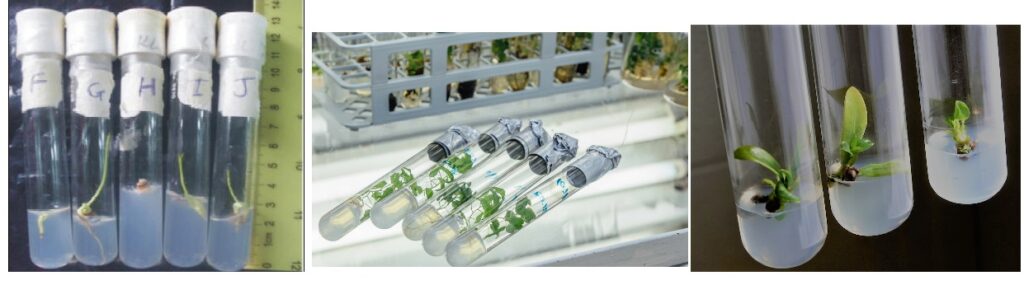
Plant tissue and organs are grown in vitro on artificial media, which supply the nutrients necessary for growth. A culture medium is a complete mixture of nutrients and growth regulators . The basic nutrient requirements of cultured plant cells are very similar to those of whole plants.
Murashige and Skoog medium (MS)
This is by far the most commonly used media and a ‘so-called’ standard tissue culture media. It was first developed by two brilliant scientists, Murashige and Skoog when they were trying to grow tobacco plants.
Types of Media
- Murashige and Skoog (MS) medium. This medium was invented by two scientists named Toshio Murashige and Folke K. …
- Linsmaier and Skoog (LS) medium. This medium was developed by Linsmaier and Skoog in 1965. …
- Gamborg (B5) medium. This medium was developed by O. L. …
- Nitsch and Nitsch (NN) medium. …
- White’s Medium.

MEDIA PREPARATION
There are some basic steps in the preparation of plant tissue culture media. The following is a general outline of the process:
- Add ultra-pure, laboratory-grade water to ~80% of the final volume to be prepared in an Erlenmeyer flask or beaker that is at least twice the volume of medium being prepared
- Add an appropriate-sized stir bar to the water and place flask or beaker on a stir plate; turn on stir plate for moderate stirring action
- While stirring, slowly add media components one at a time (except for gelling agent) and allow to dissolve
- Remove stir bar from flask/beaker (stir bar magnetic “puller” works best for this) and pour contents into an appropriately sized graduated cylinder; add lab-grade water to reach the final volume
- Carefully pour contents back into flask/beaker, add the stir bar, and place on stir plate near a pH meter; add gelling agent (i.e. agar, gellan gum, agarose, etc.) and allow to mix while stirring
- Calibrate pH meter with appropriate calibration buffers (generally pH 4 and 7 are sufficient), then insert tip of probe into medium while stirring
- Add appropriate acid or base solution (generally 0.1-1M hydrochloric acid or potassium hydroxide) dropwise to medium for adjusting to desired pH*
- Place flask/beaker on stir/hot plate and turn on heat to high while stirring moderately
- Watching carefully and wearing appropriate personal protective equipment, bring solution to a boil, then promptly turn off heat to avoid boil over
- While stirring, use a peristaltic pump or similar device to evenly dispense medium into desired vessels**, then attach closures
- Place filled vessels in autoclave-safe containers and sterilize based on recommended time for the volume of each vessel
- Wearing the proper protective equipment, carefully remove sterilized media from autoclave and allow to cool in a clean environment
* Media recipes typically include a target pH that will allow the gelling agent to solidify and promote maximal growth for the species in culture. The pH of the medium will likely change (usually a decrease) after autoclaving, especially in the presence of a carbohydrate source such as sucrose. The pH change will vary based on the medium being prepared, different autoclave models, sterilization times, etc., so it is advised to test the pH of the medium both before and after autoclaving to determine how much change has occurred. Next time the medium is prepared, the pH of the medium is then adjusted prior to autoclaving to compensate for the change that was observed previously.
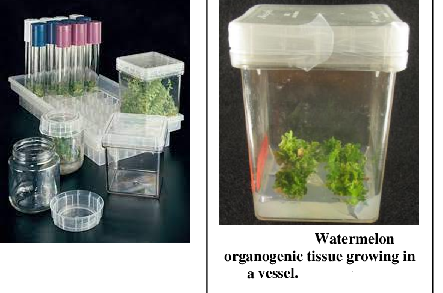
** Commonly used vessels for plant tissue culture include test tubes, Petri dishes, Magenta GA7 vessels, glass jars, and Star*Pac bags. The type of container and volume of medium should reflect the space needed for the plant material to grow before it must be repropagated. Test tubes are especially useful for culture induction since their small volume is suited to segregating explants, thus reducing loss from contamination. Since Petri dishes are shallow, wide, and easy to work with, they are ideal vessels for short-term use of small tissues, such as preconditioning nodes or shoot tips prior to cryopreservation. Both test tubes and Petri dishes come in a variety of sizes; regardless, media should typically occupy less than half the maximum volume of the vessel. Keep in mind that polystyrene Petri dishes are NOT autoclavable and so they must be filled after media sterilization in a laminar flow hood. Magenta vessels and glass jars are ideally suited to multiplying cultures that grow well at higher densities; these are typically filled to less than 15% capacity (for instance, 80 mL medium in a 575 mL Plastic covered vessel) to allow ample room for growth. Star*Pac bags may be used to save space under slow growth conditions.
Suggested media volumes for various plant tissue culture vessels:
- Test tube (150×25 mm): 20-25 mL
- Test tube (150×20 mm): 15-20 mL
- Petri dish (100×25 mm): 50-80 mL
- Petri dish (100×15 mm): 25-35 mL
- Petri dish (60×15 mm): 12 mL
- Petri dish (35×10 mm): 5 mL
- Plastic screw cap Vessel (575 mL): 50-80 mL
- Glass jars (946 mL): 150-180 mL
- Star*Pac bags: 10 mL
PLANT TISSUE CULTURE MEDIA COMPONENTS
Plant tissue culture media formulation can have a profound effect on plant growth and development. There are many different formulations that have been developed over the years for a multitude of plant species, but a few are more commonly used for the greater part of plant tissue culture work. The Murashige & Skoog formulation (1962) is by far the most common base medium used today, but there are other effective media frequently used. These include those reported by White (1963), “Gamborg’s B-5” by Gamborg et. al. (1968), Schenk and Hildebrandt (1972), Nitsch and Nitsch (1969), and “Woody Plant Medium” by Lloyd and McCown (1980). These media formulations can either be made from liquid stock solutions of salts and vitamins or purchased as pre-blended packets in powder form.
There are many components and additives that can be used in plant micropropagation media, but most can be placed into eight categories: water, nutrient salts (micro and macronutrients), vitamins, amino acids, carbohydrates, gelling agents, growth regulators (hormones), and other organic supplements. The following is a summary of each component category:
♦ Water- Plant culture media are water-based, generally comprising 90+% of the total components. It is important to use ultra-pure water so no minerals or other impurities affect plant growth. This is accomplished by either distillation or reverse osmosis.
♦ Nutrient salts- Nutrient salts provide the “macro” and “micro” elements necessary for plant growth. Macronutrients are required in larger quantities (1-60 mM) and include nitrogen, phosphorus, potassium, calcium, magnesium, and sulfur. Micronutrients are required in smaller quantities (0.1-100 µM) and include iron, manganese, zinc, boron, copper, molybdenum, cobalt, and iodine. Sodium and chlorine are also added to some media but are not considered essential for plant growth. Macro and micronutrients are generally added to the medium as salts in a form that is more easily available for use by plants. Examples of nutrient salts include calcium nitrate, potassium chloride, and magnesium sulfate. Iron and zinc are sometimes added in a chelated form to aid in availability and avoid precipitation of those elements. Common chelating agents include EDTA or EDDHA.
♦ Vitamins- Plants grown in vitro often lack the ability to synthesize vitamins, in contrast to plants grown in soil or other substrates. Various vitamins are added as supplements to plant tissue culture media to provide compounds that act to stimulate certain metabolic functions. Vitamin supplements are generally used at rates of 0.1-10 mg/L and include thiamine, nicotinic acid, pyridoxine, and myo-inositol.
♦ Amino acids- Certain amino acids are added to plant tissue culture media and can be beneficial for plant cell growth because they are a readily available source of nitrogen that is sometimes easier for plants to absorb than from inorganic sources. Amino acid mixtures, such as casein hydrolysate, or single amino acids, such as glycine, glutamine, or adenine, may be added to the media at varying rates ranging from 2-1000 mg/L.
♦ Carbohydrates- Most in vitro plants are not capable of producing their own carbohydrates from light, water, and carbon dioxide, as they are in the natural world. A carbohydrate source must be supplied to the medium for plant growth. The most commonly used carbohydrate source is sucrose, but glucose, fructose, and maltose are also used at rates of 20-30 g/L. The effect of carbohydrate source and amount used in the medium varies with different species of plants.
♦ Gelling agents- Plant tissue culture media are usually supplemented with a gelling agent or a mixture of several agents. The purpose of gelling agents is to provide physical support to the plant being cultured. Agar (derived from the red algae Gracilaria) is a frequent gelling agent, but gellan gum (derived from the Sphingomonas bacterium) is also used alone or in combination with agar. Agarose (extracted from certain types of red seaweed) is used to a lesser extent, especially for pollen culture. Different plant species may have better growth using a certain gelling agent or a mixture of several, so testing is recommended. In some cases, plant responses may vary dependent upon the manufacturer or the purity of the gelling agent. If no gelling agent is used, such as for suspension cell cultures, either continuous shaking of the culture on a shaker table or, in the case of shoot cultures, a support system of some type (such as a paper “raft”) may be necessary.
♦ Growth regulators- Plant tissue culture media are commonly supplemented with plant growth regulators (PGR’s) to achieve the desired growth characteristics for the target plant species/cultivar. There are four main groups of PGR’s: auxins, cytokinins, gibberellins, and abscisic acid. Auxins and cytokinins are the most used and are often applied in combination with each other. Auxins tend to stimulate root and callus initiation and growth, whereas cytokinins tend to favor axillary and adventitious shoot formation and growth. Gibberellic acid is used to stimulate shoot elongation and abscisic acid can promote and increase overall quality of somatic embryos.
The most common auxins employed in plant tissue culture media include indoleacetic acid (IAA), indolebutyric acid (IBA), naphthaleneacetic acid (NAA), and 2,4-dichlorophenoxyacetic acid (2,4-D) and are used at rates of 0.01-10 mg/L. Commonly used cytokinins include benzyladenine (BA), kinetin, and zeatin, used in the range of 0.1-10 mg/L. Most PGR’s can be autoclaved together with other media components, however if a critical concentration is required, filter-sterilization and addition after autoclaving is recommended.
Since microscale amounts of PGR’s are used in culture media, stock solutions (usually in a defined concentration of X mg/mL) are used to aid in measuring out the desired amount conveniently and accurately. Most PGR’s should be dissolved into an appropriate solvent (such as ethanol, DMSO, sodium hydroxide, hydrochloric acid, etc.) prior to dilution for the final concentration of the stock solution. Stock solutions should be stored refrigerated or frozen.
♦ Other organic supplements and antioxidants- There are numerous other organic compounds that can be beneficial to plant growth in tissue cultures. These may include coconut milk, protein hydrolysates, malt extract, and activated charcoal (AC). Activated charcoal is sometimes added to plant cultures where plant tissues produce oxidized phenolic compounds or other impurities that may become toxic overtime. Adding AC to the medium at a rate of 0.5-5 g/L can help adsorb toxic compounds that would otherwise have a negative impact on growth.
Antioxidants and antioxidant-like compounds are sometimes added as a supplement to plant tissue culture media to prevent or minimize reactive oxygen species (ROS) that can cause oxidative damage to plant tissues. Ascorbic acid, citric acid, glutathione (reduced form), lipoic acid, glycine betaine, D-tocopherol (vitamin E), salicylic acid, and polyvinylpyrrolidone (PVP) have all been shown to have potential to inhibit ROS formation, but their effects vary widely between different plant species. At the National Laboratory for Genetic Resources Preservation, in Fort Collins, CO, Vitis single-node microcuttings and shoot tips are treated with a mixture of 1 mM ascorbic acid, 1 mM glutathione (reduced form) and 0.1 mM salicylic acid in the pretreatment and preculture media, respectively (Bettoni et al. 2019). This treatment has been shown to significantly improve shoot regrowth after the cryopreservation process, likely due to its antioxidant effects. Similarly, Uchendu, et al. (2010) found that adding either glutathione (reduced), lipoic acid, or glycine betaine to varying steps of the cryopreservation process significantly increased regrowth of cryopreserved shoot tips.