When it comes to electrical conductivity, water and ice are two states of the same substance. Whether in its liquid or frozen form, water is an excellent conductor of electricity. This is because water molecules are able to easily form ions, which are electrically charged particles that allow electricity to flow freely through them. While ice is a good conductor of electricity, it is not as good as water. This is because the ice molecules are not as mobile as the water molecules, and so they are not as easily able to form ions. However, this does not mean that ice cannot conduct electricity, as it is still a very good conductor.
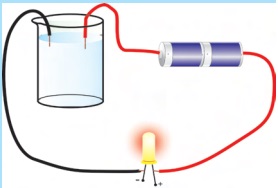
Solids, liquids, and gases are three fundamental types of matter. Because it is a crystalline form of water, ice is an insulator because of its low ionic mobility. Water, in contrast to ice, conducts electricity in a liquid form. Water’s existence is due to the presence of dissolved ions and salts. NaCl, on the other hand, prefers to remain as a single NaCl and carry its own electrical charge. When an electric current or voltage is applied to one terminal of the opposite terminal, an ions travels through the water to that terminal. When these ions continue to travel inside the closed-circuit loop, the substance keeps conducting electricity.
Ions are not present when ice forms from pure water. Because ice is solid and frozen, charged particles cannot travel through because the medium is too thin. As a result, the ions’ movement is restricted. As a result, ice is an extremely weak conductor of electricity. An electron can carry electricity because it is a charged particle. As a result, electrons move toward the positive terminal when there is a potential difference across two terminals in a metallic conductor, and an electrical circuit is completed. Electricity cannot be generated by ice because of the presence of ionic particles and low mobility of ions.
When ions move through a substance, current flows through it. In ice, however, dissolved ions become restricted in their movement, as they are frozen in place and cannot freely move. Ice is considered a poor conductor of electricity as a result.
How is ice energy (inductance) proportional to its weight? Yes, but it has a bad conductor. It takes some time for the ions of H to travel around.
This substance does not cause electricity, and it can be used to clean machines and electrical systems while they are still running.
Ice is a good example of electrical conduction by proton transfer because oxygen atoms do not migrate in a perfect crystal, as opposed to liquid water. In fact, intrinsic electronic semiconductors are similar to intrinsic electronic transistors.