spherometer is an instrument used for the precise measurement of the radius of curvature of a curved surface. Originally, these instruments were primarily used by opticians to measure the curvature of the surface of a lens
A spherometer usually consists of:
- A frame with three legs, arranged in an equilateral triangle of known radius. The outer legs of some spherometers can be moved to a set of inner holes in order to accommodate a smaller surface. The lower ends of the legs are finely tapered and terminate in hemispheres.
- A central leg, which can be raised or lowered via a screw.
- A reading device for measuring the distance the central leg is moved. Often this consists of a marked dial attached to the top of the screw and a vertical scale attached to the frame. This both indicates the number of turns of the screw and serves as an index for reading the divisions on the dial. A lens may be fitted in order to magnify the scale divisions.
On new spherometers, the vertical scale is marked off in units of 0.5 mm. One complete turn of the dial also corresponds to 0.5 mm and each small graduation on the dial represents 0.005 mm. The graduations on old spherometers are 0.001 mm.
Principles of operation
To measure the radius of a sphere—e.g. the curvature of a lens—the spherometer is leveled and read, then placed on the sphere, adjusted until the four points exert equal pressure, and read again. The difference gives the thickness of that portion of the sphere cut off by a plane passing through the three feet. A contact-lever, delicate level or electric contact may be attached to the spherometer in order to indicate the moment at which the four points exert equal pressure.
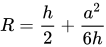
The spherometer directly measures a sagitta, h. If the mean length between two outer legs is a, the spherical radius R is given by the formula𝑅=ℎ2+𝑎26ℎ
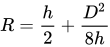
Using a spherometer with a circle cup of diameter D, the spherical radius R is instead given by the formula𝑅=ℎ2+𝐷28ℎ