
Algae can be found in all types of natural waters, including salt water, fresh water, and brackish water (a mix of salt and fresh water). A few types of algae produce toxins. In these algae, toxin production can be stimulated by environmental factors such as light, temperature, salinity, pH, and nutrient levels.
Scenedesmus, which belongs to the order Chlorococcales of the family Scenedesmaceae, is frequently dominant in freshwater lakes and rivers and is commonly found in fresh and brackish waters, particularly under nutrient-rich conditions .
Most algae are eukaryotes, although the term algae is also used to describe photosynthetic prokaryotes such as cyanobacteria. The main difference between prokaryotes and eukaryotes is their cell structure. Prokaryotes are single-celled organisms that range in size from one to 10 micrometers (μm).
Scenedesmus is a genus of green algae, in the class Chlorophyceae. Scenedesmus is widely produced for aquaculture purposes, mainly due to its high lipidic content. Scenedesmus biomass has been proposed for the obtention of a variety of biofuels including biohydrogen, biodiesel, and bioethanol.
Aquatic plants: Algae grow on and inside water plants (including other algae), but are generally not restricted to a single host. ‘Artificial’ substrates: Wooden posts and fences, cans and bottles etc. all provide algal habitats. Billabongs & lagoons: Rich microalgal habitats, particularly for desmids.
Scenedesmus sp. are common freshwater green algae (An et.al., 1999). They are used as pollution indicator where they can adapt and grow well in polluted water or sewage. (Brettum & Andersen 2005 and Shubert et al., 2014).
Scenedesmus species are used experimentally to study pollution and photosynthesis and are a potential source of biodiesel. In sewage purification processes, the algae provide oxygen for the bacterial breakdown of organic matter and thereby help to destroy other harmful substances.
Habitat: Green algae can be found in all types of habitats including ponds, lakes, rivers and soil. Most greens prefer freshwater, but a few also grow in brackish and marine waters. Some freshwater filamentous greens can be found in fast moving currents attached to rocks and roots or simply floating on still waters.
Scenedesmus dimorphus
The production of biofuels using algae is an attractive technology that could mitigate the ongoing depletion of fossil reserves and their impact onimpacts/influence on climate change. Open pond mass cultivation of the green alga Scenedesmus dimorphus is considered as one of the most promising strategy for cost effective production of algae. Again, with the recent implementation of those culture strategies, multiple reports of parasitic attacks that can destroy mass cultures in a matter of days have been reported raising concern for this developing sector. Amoeboaphelidium protococcarum belong to the Cryptomycota clade and has been recently described in a study by Letcher et al, 2014
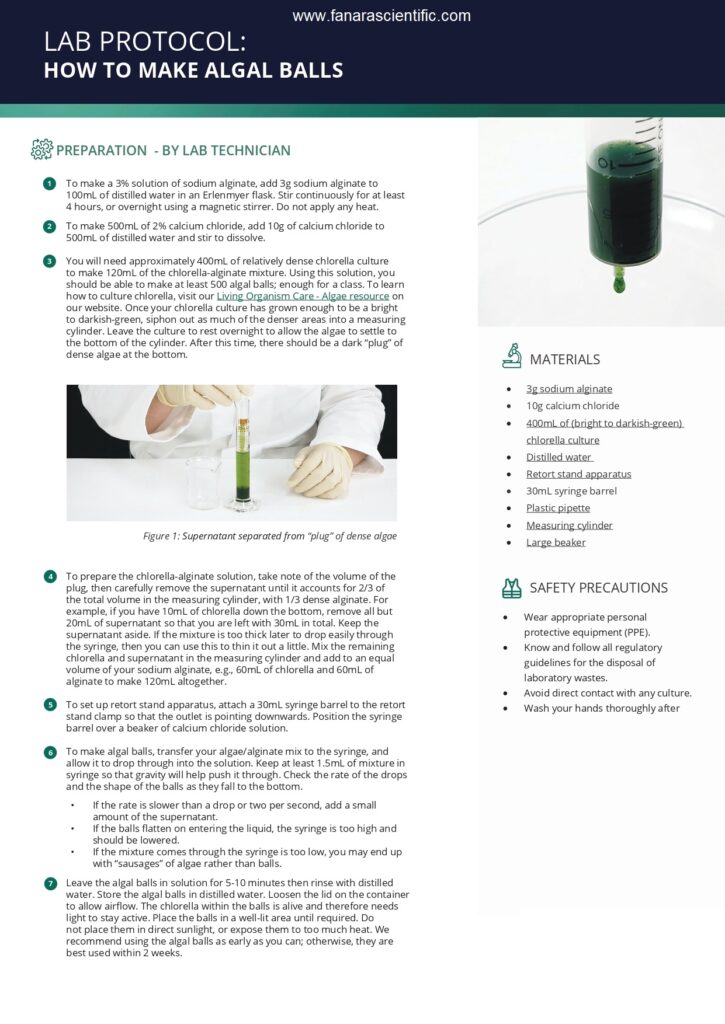
Algae Ball Preparation
Video how to preparation of Algae balls
Algae 5ml Add with 2% Sodium Alginate Solution, add into Calcium chloride 2% solution.