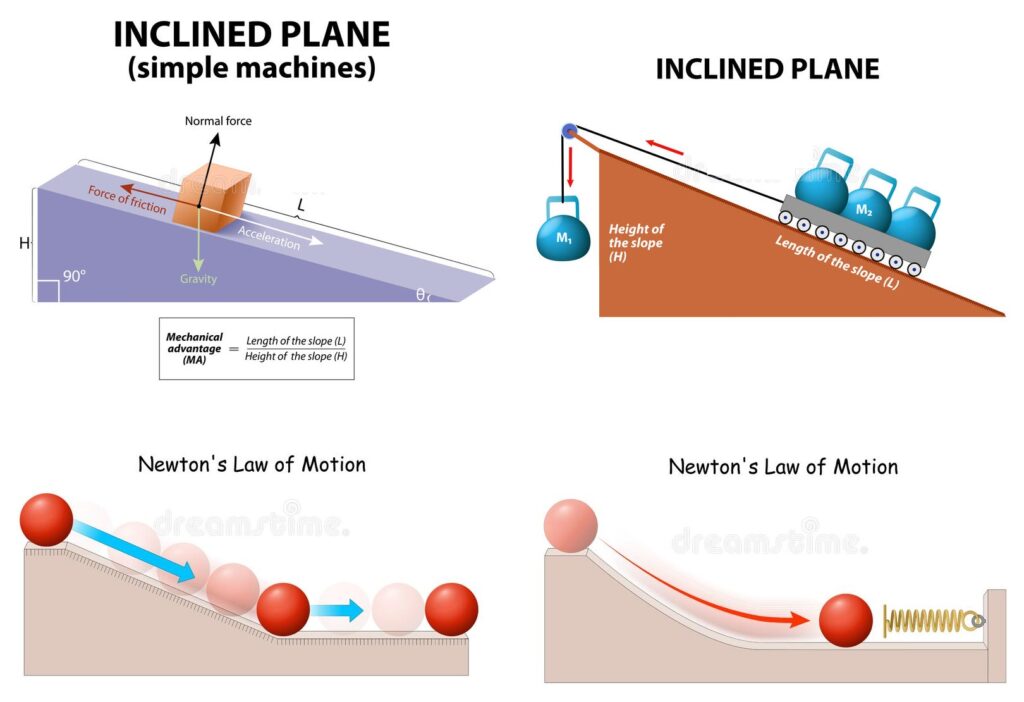
newton 2nd Law, Friction, Acceleration, Gravity

Inclined plane with protractor and pulley, roller, weight box, spring balance, spirit level, pan and thread.
What is the inclined plane apparatus?
inclined plane, simple machine consisting of a sloping surface, used for raising heavy bodies. The force required to move an object up the incline is less than the weight being raised, discounting friction. The steeper the slope, or incline, the more nearly the required force approaches the actual weight.
How do you find the acceleration of an object on an inclined plane?
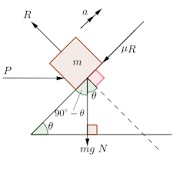
If a particle of mass m is placed on a smooth inclined plane (i.e. the frictional force F=0 ) and released it will slide down the slope. To find the acceleration of the particle as it slides we resolve in the direction of motion. F=ma,mg cos(90∘−θ)=ma,g cos(90∘−θ)=a,g sin(θ)=a.
What is the acceleration component along the inclined plane?
In an Inclined Plane Forces and Acceleration
So the force causes the acceleration component of the force of gravity acting down the slope denoted by (FD). The gravity force is resolved into two components that are denoted as FD and which is parallel to the slope which is FP perpendicular to the slope.
Video = What was the result of the inclined plane experiment?
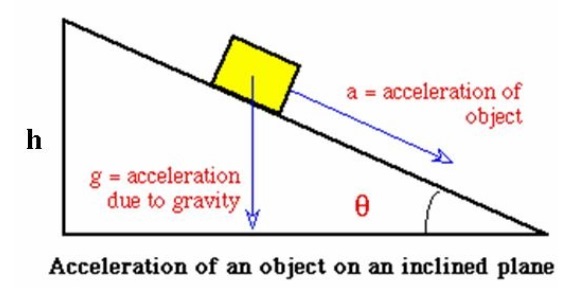
It show that the longer travel distance of rolling object on inclined plane, the faster it will move. With constant acceleration, the velocity of an object will get increasingly faster.
Video = How do you measure acceleration on a ramp?
Acceleration on a ramp equals the ratio of the height to the length of the ramp, multiplied by gravitational acceleration. Acceleration on a ramp equals the sine of the ramp angle multiplied by gravitational acceleration.
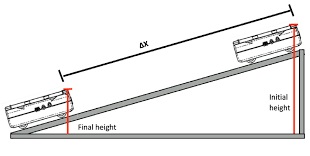
Theory:
Galileo Galilei used an inclined plane with minimal friction to observe motion due to gravity. The
track in this experiment is more technically sophisticated, but the idea is the same as it was 400 years
ago. The height of the incline can be adjusted to change the angle of the slope.
Assuming friction is negligible, an object that slides down an inclined plane is subject to a constant
acceleration (a). This acceleration is due to the gravitational acceleration (g) but the acceleration on the
slide is reduced because the track is at an angle.
Near the Earth’s surface, the gravitational acceleration is g =
9.8 m/s2
.
a = g sin(θ) = g
h(1) where = ∆x is the distance
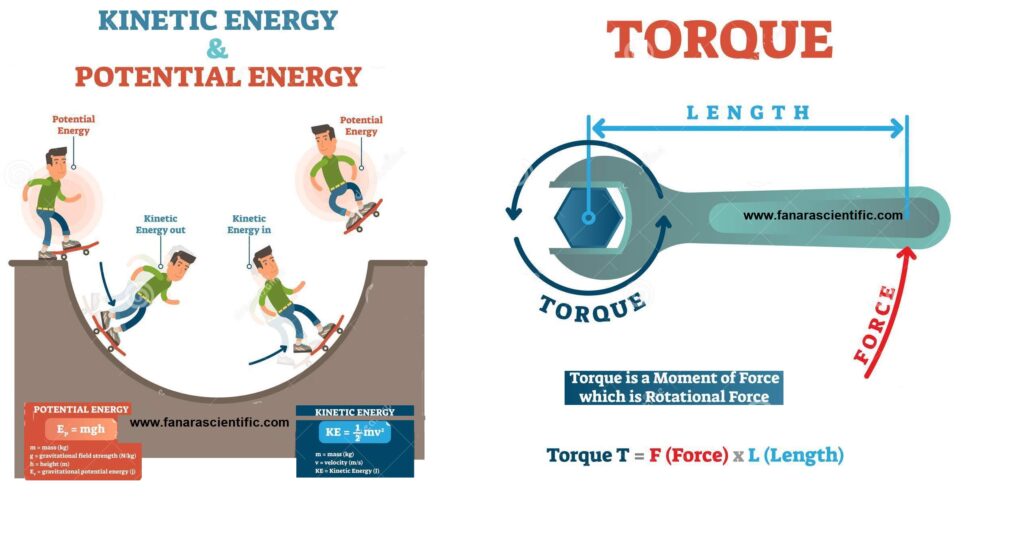
Conservation of Energy
The Work Energy theorem states that W = ∆KE, work is
the change of the kinetic energy. Work is also defined as
W = |F~ ||∆~x| cos θ, the component of an applied force along the displacement ∆x. We can divide work
by the type of force that generates it:
- Conservative : These are forces that do not remove energy from the system. They can be
represented by a potential energy. Examples are springs, gravity, and the electromagnetic fields. - Non-conservative : These are forces that do remove energy from the system. They cannot be
represented as a potential energy. Examples are friction, heat, and sound.
When a force can be represented as a potential energy it means energy can be transferred between
kinetic and potential without loss. This allows us to write the Work Energy theorem as
Wnc = ∆KE + ∆P E, (2)
where Wnc is the work done by any non-conservative forces. In ideal situations Wnc = 0 and this
becomes
0 = ∆KE + ∆P E,
KEi + P Ei = KEf + P Ef ,
or the sum of the kinetic and potential energies must remain constant.
Today, we will test this relationship using a cart moving down an incline plane. The cart is started
from rest from the top of the track and the speed is measured along the track using Capstone software.
Potential energy (PE= mgh) is calculated by measuring the height and kinetic energy (KE= 1/2mv2
)
is calculated from the speed. Initially when the cart is not moving all of its energy is stored as PE but
when the cart is released it rolls freely down the track and its stored PE is converted to KE.
If there is friction in the system this transfer of energy from PE to KE will not be complete. The
work done by kinetic friction can be represented as
Wf = KEf − P Ei
,
−fk∆x = KEf − P Ei
,
−µk|n|∆x = KEf − P Ei
,
−µkmg cos θ∆x = KEf − P Ei
,
where µk is the coefficient of kinetic friction, m is the mass of the cart, and θ in this equation is
the angle at which the track is inclined. Notice that the sign of the work done by kinetic friction is
negative. Recall that the frictional force opposes motion, so the displacement vector and force vector
are in opposite directions. For today’s experiment we will assume all energy losses are because of a
global friction in the system, the sides wheels on the track groove, the axles rotating, air resistance,
etc. Therefore, any losses will be attributed to a single µk parameter in the analysis.