Kundt’s tube is an experimental acoustical apparatus invented in 1866 by German physicist August Kundt for the measurement of the speed of sound in a gas or a solid rod. The experiment is still taught today due to its ability to demonstrate longitudinal waves in a gas.
MAS 5274 A Kundt’s Tube Apparatus Supplied with Tuning Fork
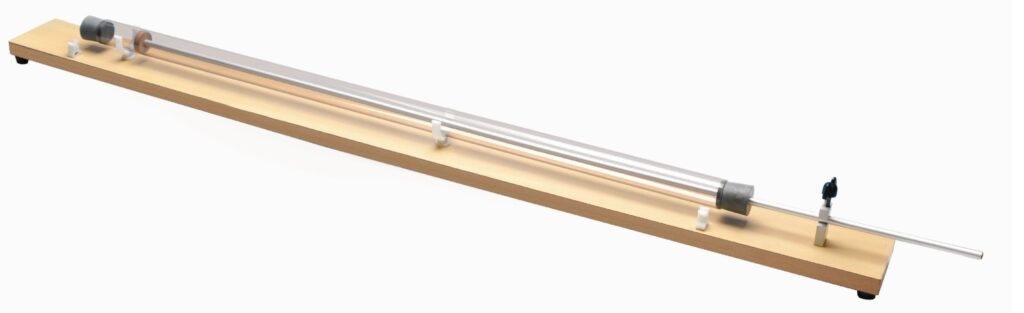
Measure the length of acoustic waves in air or other gases with this all-in-one apparatus
Consists of a glass tube 80cm long and 32mm in diameter. At one end is a tightly fitting but adjustable cork piston fitted to a metal rod 100 cm long and at the other end, a loose fitting piston attached to a rod, 100 cm in length and 8 mm in diameter. Lycopodium powder (not supplied) can be used to show nodal points.
Why does the brass respond to the rosin cloth by producing sound?
What is the significance of the clamp?
Why does the brass rod have to be clamped at its midpoint?
Why does the cork dust pile up?
How do the measurements you are asked to make lead to the speed of sound in brass?
Part 5: Speed of Sound in Brass
Kundt's Tube
Brass Rod
Clamp (At midpoint)
Cork Dust
Wooden Base
Option use Tuning fork to create sound waves in tube.
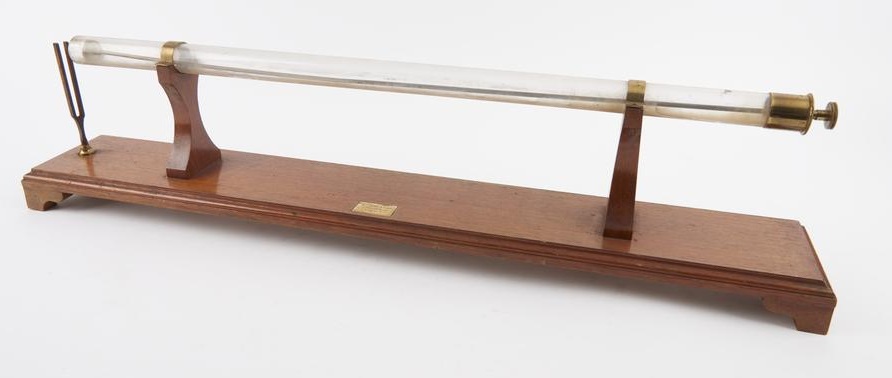
Kundt’s tube is an acoustical apparatus, invented by German Physicist, August Kundt (1866).
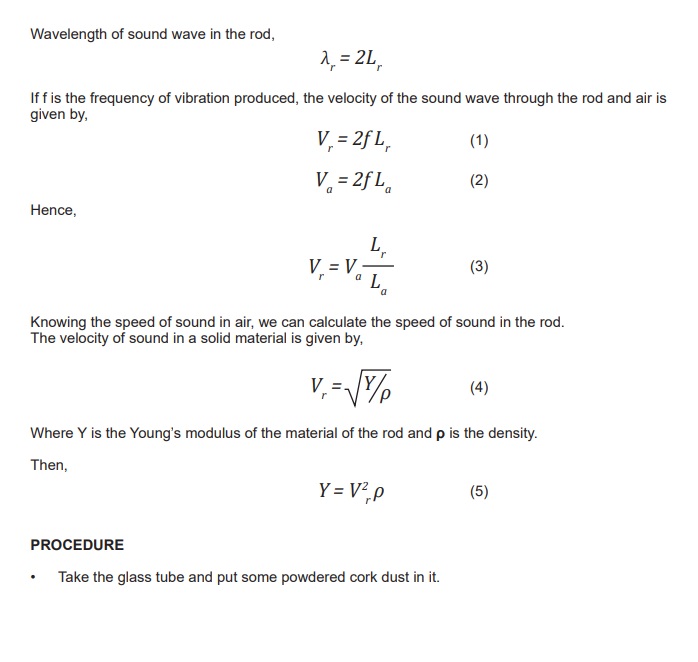
Knowing the speed of sound in air, the speed of sound V in a solid rod can be calculated based on
the measurement of sound wavelength, λ. If the frequency of the sound wave, f is known, we can
calculate the speed of sound as,
KUNDT’S TUBE APPARATUS
The apparatus consists of a long transparent horizontal pipe G, which contains a fine powder such
as cork dust or talc. At one end of the tube, a metallic rod AB, of uniform radius is introduced. This
rod is clamped at the middle and carries a circular disc D, rigidly fixed at one end. The radius of
the disc is slightly less than the radius of the glass tube. The rod is inserted a few centimeters
inside the tube, without touching it. The other end of the glass tube is closed by a piston, P. The
position of the piston can be adjusted by moving it in or out. The whole apparatus is tightly
clamped on a table, so that there will be no jerks on the tube during the experiment.
The schematic diagram of a Kundt’s tube is shown below.
The tube is dried and fixed in position after spreading a thin layer of cork dust in it. When the rod is
set into longitudinal vibrations at its fundamental frequency by rubbing it with a piece of rosined
leather at B, the ends of the rod act as anti-nodes and the middle point acts as node. The length of
the metal rod is equal to half the wavelength of the sound wave in the material of the rod. The disc
begins to vibrate backward and forward. The air inside the glass tube is set into forced vibrations
with the frequency of the wave emitted and stationary waves are produced by reflection at the
piston. On altering the position of the piston, a point is reached where an overtone of the air
column coincides with the fundamental of the rod, and thus produces resonance within the tube. At
this stage, the cork dust in the tube is violently agitated and collected as heaps at the nodes. The
average distance between the successive heaps will be equal to half the wavelength of sound in
air.
If La be the mean distance between the consecutive nodes of cork dust in air and Lr, the length of
the metal rod, then, Wavelength of sound wave in air,
λa = 2La
PROCEDURE
- Take the glass tube and put some powdered cork dust in it.
- By fast rotatory movement, distribute the powder uniformly inside the tube.
- Fix the tube tightly with the holder.
- Tightly clamp the metal rod at the centre.
- The piston is introduced to the other end of the glass tube.
- The rod is rubbed at B, lengthwise with a piece of rosined leather and set into longitudinal
vibrations at its fundamental frequency. - Move the piston in and out of the tube till the resonance is obtained.
- Now the cork dust inside the tube becomes deposited as heaps.
- Select the position of the extreme nodes very carefully and measure the distance between
them. Find the number of heaps and calculate the average distance between two consecutive
peaks. - Note the length of the rod and repeat the experiment.
- We have the velocity of sound through air equals, 343m/s.
- Using equation (3), the velocity of sound through the rod can be calculated.
- The Youngs modulus of the rod can be calculated from equation (5).
- NOTE
- The glass tube must be perfectly dry as moisture afects sound velocity.
- The metallic rod should be clamped exactly at the middle.
- The powder must be evenly spread.
- The disc should not touch the glass tube, since it causes the tube to break.
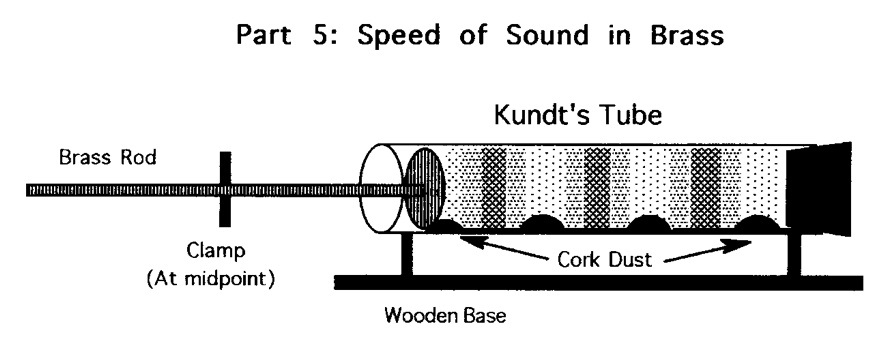
Kundt’s tube is one tool to visually display sound by inserting fine styrofoam into its tube. Using this tool also can be used to measure the sound wavelength directly using an ordinary ruler.
