

Features
- High performance track and accessories, reliable and durable
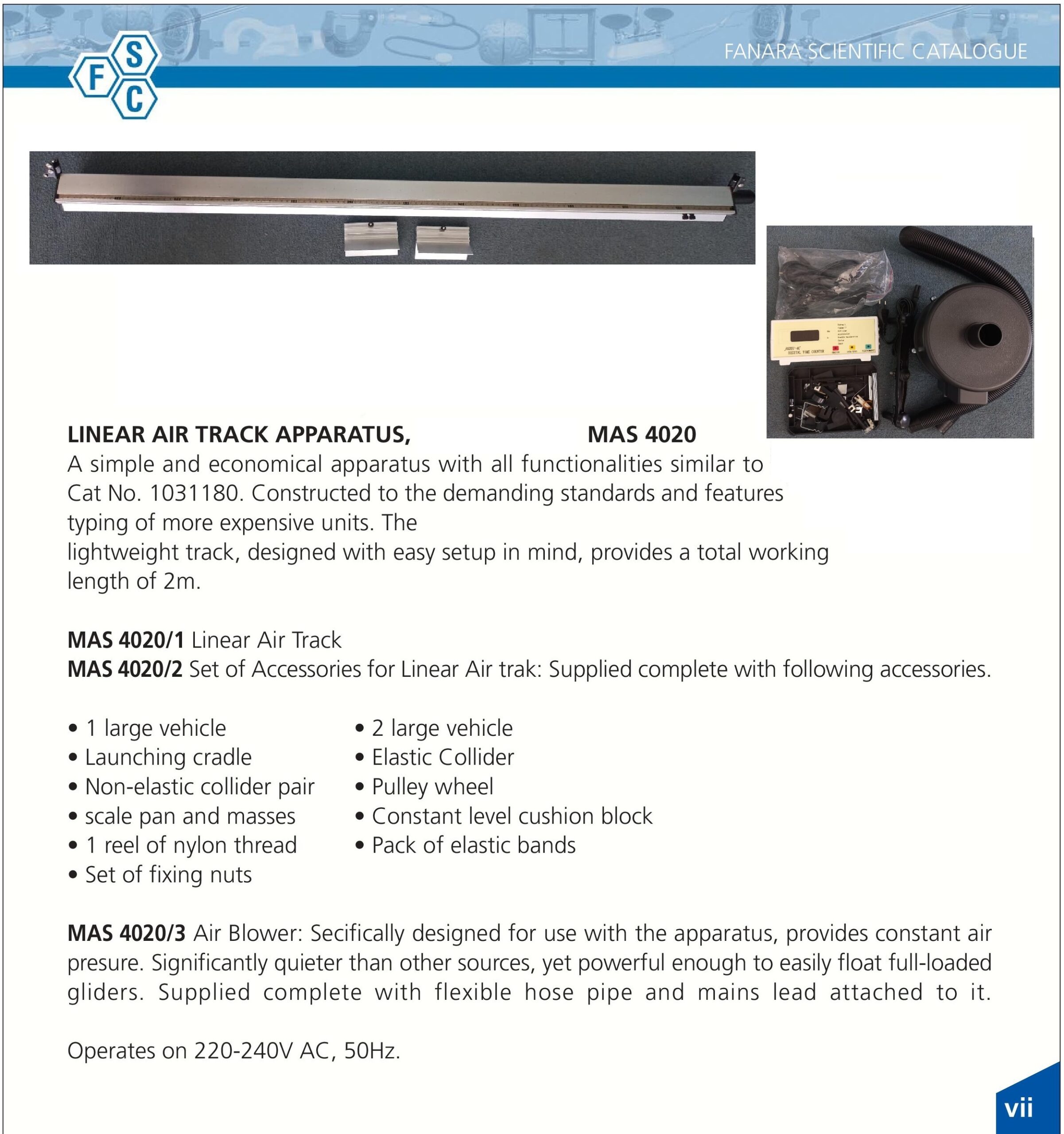
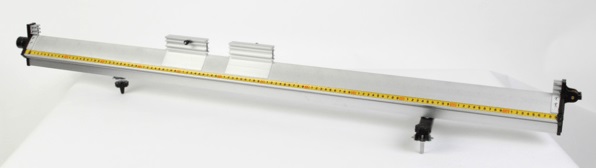
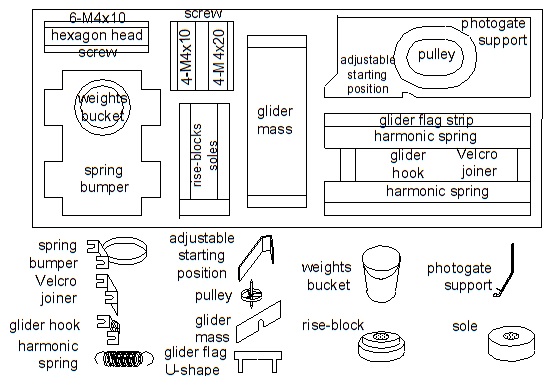
- Include air track & accessories, timer, and air supply
- Easy to use and clean
- Affordable
Introduction
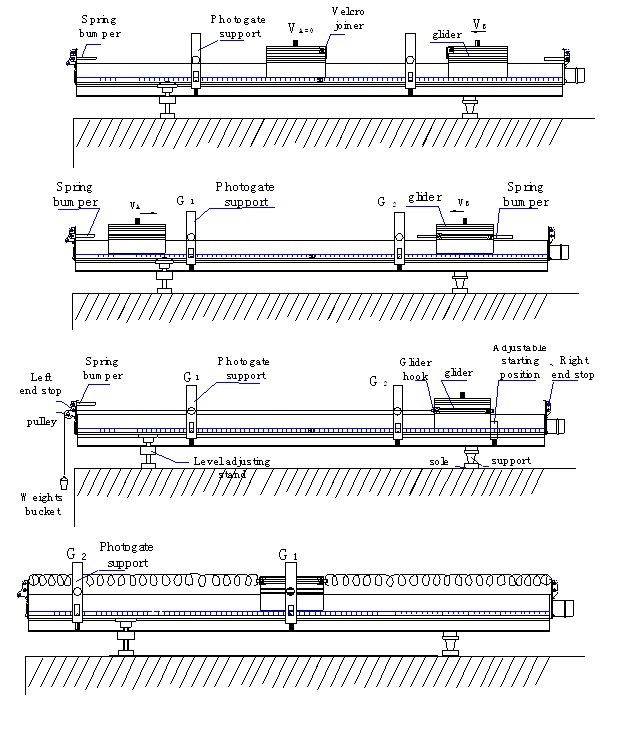
This air track experiment apparatus is designed based on the Air Cushion principles. When an air track is connected with an air blower, compressed air is sprayed from the holes on the surface and form a thin air layer. This air layer will fill the space between the air track and the inner surface of a glider. As a result, the movement of the glider can be regarded as friction-free movement. With the help of an air blower and a digital timer, the air track can be used to experimentally study important physics concepts such as velocity, acceleration, momentum, collision, and kinetic. It is an ideal experiment instrument for physics teaching.
Using this apparatus, the following experiments can be conducted:
1. Determine the velocity of an object in uniform rectilinear motion, and verify Newton’s First Law
2. Determine the average velocity and instantaneous velocity of an object in variable rectilinear motion
3. Determine the acceleration of an object in uniform acceleration rectilinear motion
4. Study the relationship between distance and time of an object in uniform acceleration rectilinear motion
5. Determine the gravitational acceleration
6. Verify Newton’s Second Law
7. Verify Newton’s Third Law
8. Verify kinetic energy theorem
9. Verify momentum theorem
10. Verify momentum conservation law
11. Verify mechanical energy conservation law
12. Study simple harmonic vibration
13. Measure the stiffness coefficient of a spring
14. Measure the period of simple harmonic vibration
15. Verify the amplitude of an object in simple harmonic vibration is irrelevant with the period
16. Demonstrate elastic collisions of objects on air track
Air Track used for Acceleration
NEWTON SECOND LAW OF FORCE
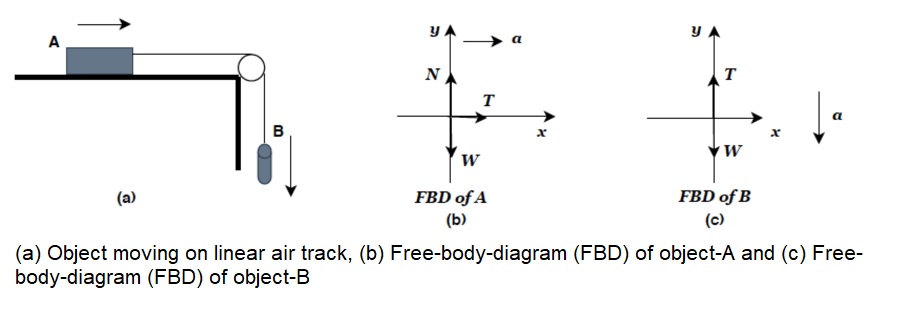
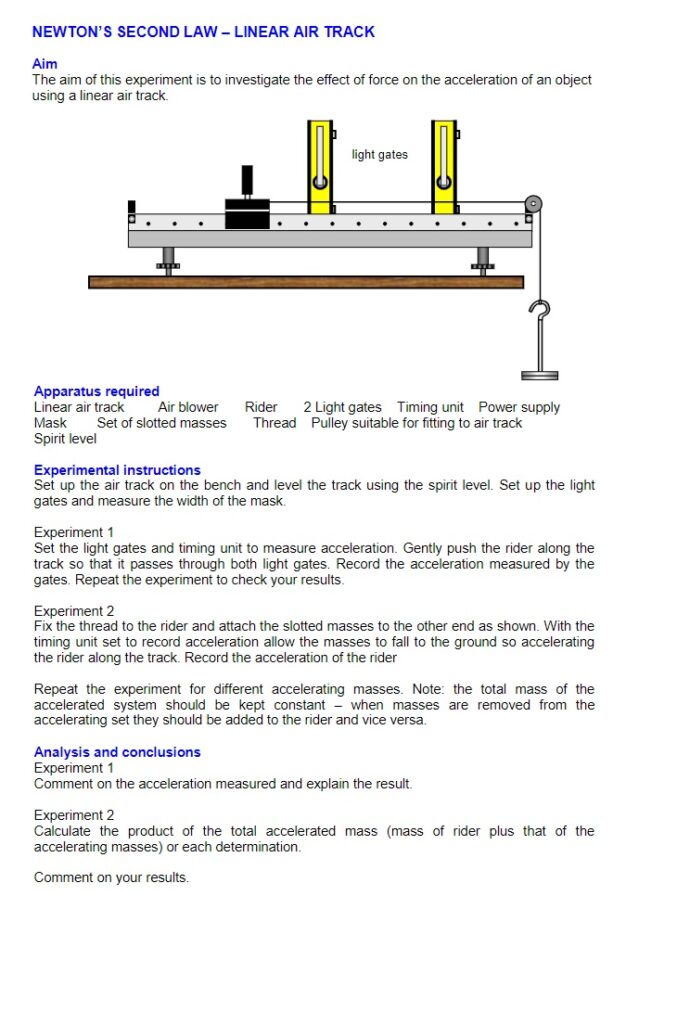
Investigate the Relationship Between Force and Acceleration
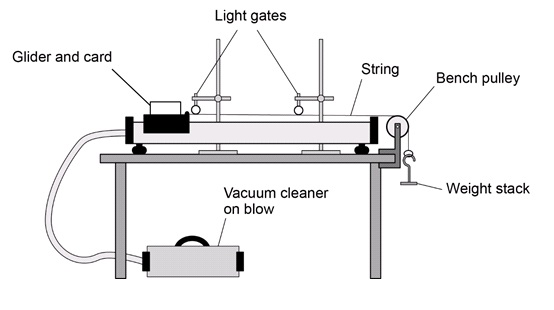
- The first experiment will investigate how the acceleration depends upon the force. The force is provided by the weight stack.
- Attach the full weight stack (1 N) to the end of the string.
- Switch on the software.
- Make sure the glider is in position and switch on the vacuum cleaner.
- The glider should accelerate through the light gates towards the bench pulley.
- Record the acceleration. Repeat.
- If the two values are not similar, repeat again.
- Record your readings in a table such as the one below. Calculate the mean.
Force in N, Acceleration in cm/s2
First reading, Second reading, Third reading, (if necessary) Mean
- Remove one weight (0.2 N) and attach that to the glider. This will keep the total mass constant. (The weight stack is being accelerated too.)
- Repeat the experiment for a force of:
- 0.8 N
- 0.6 N
- 0.4 N
- 0.2 N
Remember to attach each weight to the glider as it is removed from the weight stack.
- Plot a graph with:
- ‘Acceleration in m/s2’ on the y-axis
- ‘Force in N’ on the x-axis.