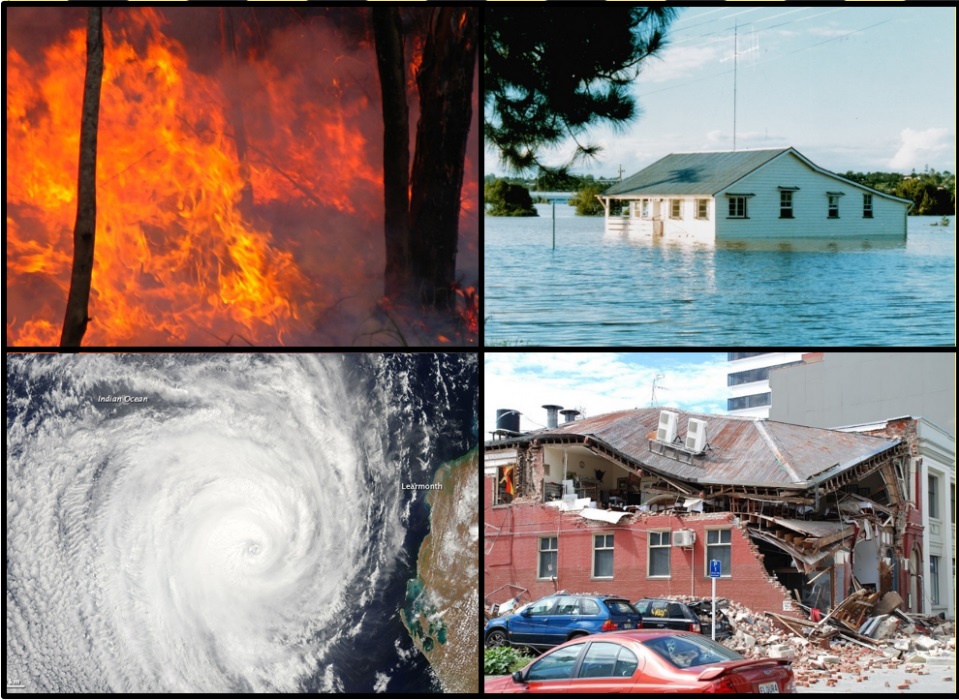
| Hazard | Disaster |
| * Hazard is a threat. *A hazard is a dangerous physical condition or event. | *A Disaster is an event. It is a calamity or tragedy or a consequence of a hazard. *Natural hazards that cause great loss to human life and economy are called disasters and catastrophes. A disaster disrupts the normal function of a society. |
| *Earthquakes, floods, volcanic erruption, landslides, droughts etc. are called natural hazards before they cause great loss of life and damage to property. | *It causes damage to property and loss of life but it also disrupts the opportunities of employment. |
| *Small number of people are effected | *A large number of people are effected |
| *It may cause injury, loss of life or damage of property. | *It causes wide spread loss to life and property. |
| *Earthquakes, floods, volcanoes, tsunami, land slide, drought etc. are natural hazards. | *It affects the society to such an extent that external aid becomes sate the losses. |
- Every disaster is unique in terms of the local socio-environmental factors that control it, the social response it generates, and the way each social group negotiates with it.
- There are three observations on disasters which are as follows:
- The magnitude, intensity, frequency, and damages caused by natural disasters have increased over the years.
- There is a growing concern among people the world over to deal with the menace created by these so that the loss of human life and property can be minimized.
- Significant changes have taken place in the pattern of natural disasters over the years.
- Man has been bearing the brunt of natural disasters since ancient times. There are many disasters which man is unable to face or prevent from happening.
- They are destined to bring the tragic consequences of human destruction. Due to human intervention in the natural processes, the destructive power and frequency of natural disasters have increased considerably.
- According to UN statistics, natural disasters kill 1,00,000 persons on average and cause property damage worth billions of dollars per year. Among the top ten natural disaster-prone countries, India stands second after China.
- People used to correlate hazards and disasters. Areas prone to natural hazards were more vulnerable to disasters. Hence, people avoided tampering with the delicate balance that existed in a given ecosystem. People avoided intensification of their activities in such areas and that is how disasters were less damaging.
- With the advent of technology and the rise in population density in certain parts of the world, human beings tend to intensify their activities into disaster-prone areas increasing their vulnerability to disasters.
- Colonization of flood plains and seaward extension of port cities etc. make them vulnerable to the occurrence of floods, cyclones, hurricanes, and tsunamis.
| What is vulnerability? The vulnerability may be defined as “The extent to which a community, structure, services or geographic area is likely to be damaged or disrupted by the impact of a particular hazard, on account of their nature, construction, and proximity to hazardous terrains or a disaster-prone area.” Vulnerabilities can be categorized into physical and socio-economic vulnerability. Disasters occur when hazards meet vulnerability. |
Practice the following Questions
Q-1 Disaster management is more than just reactive responses to crises, it is a complete process that needs a fresh look in light of frequent natural calamities. Examine
Q-2 There has to be a change from focusing only on managing natural disasters to improving resilience. Comment in the context of India’s preparedness for disasters and its disaster policy.
============================================================
Water and Climate Disaster: Flood, hail storms, cloudburst, cyclones, heat waves, cold waves, droughts, hurricanes.
Geological Disaster: Landslides, earthquakes, volcanic eruptions, tornadoes.
Biological Disaster: Viral epidemics, pest attacks, cattle epidemic and locust plagues.
Industrial Disaster: Chemical and industrial accidents, mine shaft fires, oil spills.
Nuclear Disasters: Nuclear core meltdowns, radiation poisoning.
Man-made disasters: Urban and forest fires, oil spill, the collapse of huge building structures.
India is vast and diverse in terms of its physical and socio-cultural attributes. It is largely due to its vast geographical area, environmental diversities, and cultural pluralities, India is struggling with disasters for many years.
Its vastness in terms of natural attributes combined with its prolonged colonial past, continuing various forms of social discriminations and also equally large population has enhanced its vulnerability to natural disasters.
Killer waves (tsunami) struck the coastal parts of India on 26th December 2004 or the morning of 26th January 2001, when western part of India was badly affected by the earthquake or recent flash flood in the Uttrakhand or Cyclone Phalin at Odisha coast.
These are just a few examples. We always listen to such kind of news
in print or electronic media that one part of India is affected by flood whereas another faces drought. Due to the vulnerability of different kinds of disasters, it is said that India is a disaster-prone country, the reasons are:
- 85% vulnerable to single or multiple disasters
- 12% is flood-prone,
- 8% is vulnerable to cyclones and
- 57% of the area lies in high seismic zones
- 40 million hectares prone to flood = ~12% of the total area
- 8% area vulnerable to cyclone
- 68% area is susceptible to drought
- Out of 35 states and UTs- 27 are prone to one or more of these events Some areas are vulnerable to industrial, chemical and biological disasters
Classifications of Natural Hazards
Researchers have been studying disasters for more than a century. The studies reflect a common opinion when they argue that all disasters can be seen as being human-made, their reasoning being that human actions before the strike of the hazard can prevent it developing into a disaster.
All disasters are hence the result of human failure to introduce appropriate disaster management measures Hazards are routinely divided into natural or human-made, although complex disasters, where there is no single root cause, are more common in developing countries.
(1) Man-made Disasters: Disasters caused by human action, negligence, error, or involving the failure of a system are called human-made disasters. Human-made disasters are in turn categorized as technological or sociological. Technological disasters are the results of the failure of technology, such as engineering failures, transport disasters, or environmental disasters. Sociological disasters have a strong human motive, such as criminal acts, stampedes, riots, and war.
(2) Natural Disasters: Broadly, natural disasters can be classified under four categories
Agencies Involved in Disaster Management
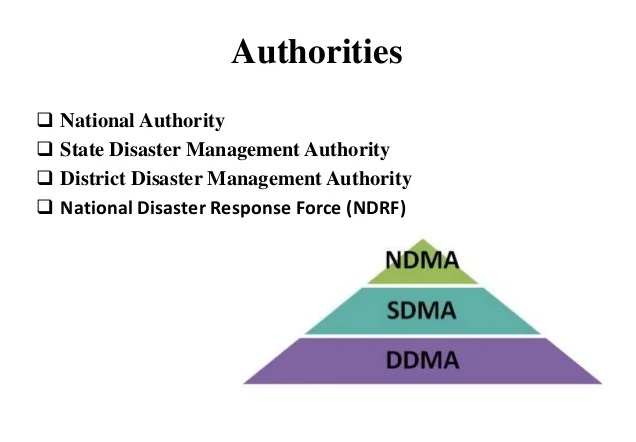
National Executive Committee (NEC):- The NEC is composed of high profile ministerial members from the government of India that include the Union Home Secretary as Chairperson, and the Secretaries to the Government of India (GoI)like Ministries/Departments of Agriculture, Atomic Energy, Defence, Drinking Water Supply, Environment and Forests etc. The NEC prepares the National Plan for Disaster Management as per the National Policy on Disaster Management.
State Disaster Management Authority (SDMA):- The Chief Minister of the respective state is the head of the SDMA.The State Government has a State Executive Committee (SEC) which assists the State Disaster Management Authority (SDMA) on Disaster Management.
District Disaster Management Authority (DDMA):- The DDMA is headed by the District Collector, Deputy Commissioner or District Magistrate depending on the situation, with the elected representatives of the local authority as the Co-Chairperson. The DDMA ensures that the guidelines framed by the NDMA and the SDMA are followed by all the departments of the State Government at the District level and the local authorities in the District.
Local Authorities:- Local authorities would include Panchayati Raj Institutions (PRI), Municipalities, District and Cantonment 11 Institutional and Legal Arrangements Boards, and Town Planning Authorities which control and manage civic services.
Practice the following Questions
Q-1 With reference to National Disaster Management Authority (NDMA) guidelines, discuss the measures to be adopted to mitigate the impact of recent incidents of cloudbursts in many places of Uttarakhand. (2016)
Q-2 Are Indian Disaster Management Agencies properly equipped to handle a major disaster. Critically analyze the strengths and weakness of Indian Disaster Management Framework.